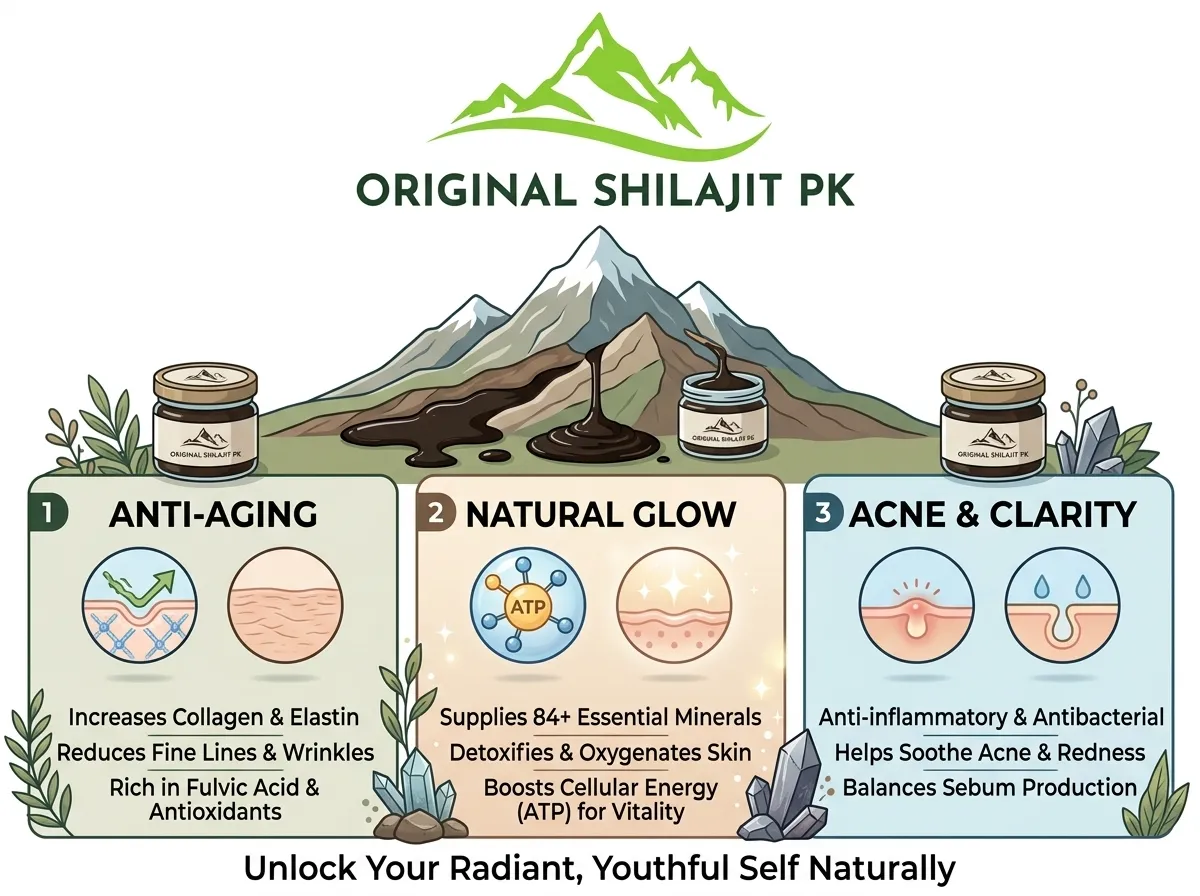
Is Shilajit good for skin? Short answer: it can help, but not the way most ads claim. Taken orally, pure Shilajit delivers fulvic acid, antioxidants and trace minerals that support your skin from the inside by fighting oxidative stress and nudging collagen activity. It is not a bleaching cream and it is not an overnight fix. Think months, not days.
We sell pure Himalayan resin sourced from Gilgit-Baltistan, and “will this whiten my face?” is easily the most common skin question we get on WhatsApp. So let me answer it properly, with the science we actually have and the parts the marketing leaves out.
Does Shilajit really work for skin, or is it hype?
Both, honestly. The mechanism is real, the evidence is early, and the marketing runs way ahead of the research.
Here is what has genuine support. Shilajit is rich in fulvic and humic acids plus more than 80 trace minerals, and its main job for skin is antioxidant. Free radicals from sun, pollution and stress break down collagen and elastin over time. That is a big part of what fine lines and dullness actually are. Antioxidants slow that damage. In a 14-week study, participants taking Shilajit showed increased activity in collagen-related genes, and a separate study found improved skin microperfusion, meaning better tiny blood flow to the skin, which is part of why some people report a healthier looking complexion.
Now the honest half. Most of this comes from ingesting Shilajit, the studies are small, and “increased a collagen gene marker” is not the same as “erased your wrinkles.” Direct research on Shilajit for skin specifically is limited. Anyone promising dramatic results is selling you something. You can read more about how fulvic acid works and the antioxidants behind these effects in our pillar guide.
Can Shilajit whiten your skin? The myth worth killing
No. Shilajit cannot bleach or whiten your skin, and any product marketed as a “Shilajit whitening cream” is stretching the truth.
This one matters because the Pakistani market is full of it. What Shilajit can plausibly do is different and more modest. By reducing inflammation and supporting better blood flow, it may help your skin look less dull, more even in tone, and generally healthier over time. That is “brighter and clearer,” not “two shades lighter.” If your goal is fairness in the cosmetic sense, Shilajit is the wrong tool, and frankly no oral supplement does that safely. Set the expectation correctly and you will actually be happier with the results.
Shilajit for wrinkles and collagen: what the science supports
The anti-aging case rests on two things: protecting the collagen you have, and supplying cofactors for making more.
- Antioxidant protection. Fulvic acid mops up free radicals that degrade collagen and elastin. In lab tests, fulvic acid raised the survival of UV-exposed skin cells by roughly 26% and blocked a large share of MMP-8, an enzyme that chews through collagen after sun damage. That is test-tube data, so treat it as promising rather than proven, but the direction is encouraging.
- Mineral cofactors. Making collagen needs zinc and copper, among others. Shilajit carries these trace minerals, which is part of why it is grouped with “collagen support” rather than being a collagen source itself. It does not contain collagen. It helps the machinery that builds it.
So for fine lines, the realistic promise is slower degradation and better skin quality with consistent use, not filler-level plumping.
Oral vs topical: should you take Shilajit or put it on your face?
This is the split almost every article glosses over, so read this part twice.
| Oral (dissolved in water/milk) | Topical (DIY face mask) | |
|---|---|---|
| What the research supports | Collagen gene activity, blood flow, antioxidant status | Very little direct evidence |
| Main benefit | Whole-body, gradual skin support | Localized, mostly anecdotal glow/soothing |
| Safety concern | Low with a purified, lab-tested resin | Higher: unpurified resin can carry heavy metals straight onto skin |
| Our honest take | This is where the actual evidence sits | Fine occasionally with pure resin and a patch test, but manage expectations |
The mechanisms people quote, collagen genes and microperfusion, come from swallowing Shilajit, not from a mask. If you want the evidence-backed route, oral is it. See our dosage and consumption guide for exact amounts.
If you still want to try it topically, and plenty of people do for acne and glow, use only lab-tested resin, mix a rice-grain-sized piece into a teaspoon of warm water or raw honey, patch test on your jaw for 24 hours, then apply for 15 to 20 minutes once or twice a week and rinse. Never smear raw, unverified resin on your face. This is exactly where the 2025 heavy-metal findings become a real concern, and skin is not the place to gamble.
Does Shilajit help acne?
It might, mainly through minerals and inflammation, but it is not an acne treatment and it will not replace one.
The plausible logic: zinc supports oil regulation and healing, and the anti-inflammatory action can calm the redness around breakouts. Some people with hormonal acne report improvement when their overall mineral status improves. That said, if you have oily, acne-prone skin, a sticky resin mask is not automatically your friend. Test cautiously, keep it thin, and if you are on prescription acne medication or have active cystic acne, talk to a dermatologist before adding anything. Women dealing with hormonal skin patterns may also find our page on Shilajit benefits for women useful for the fuller picture.
How long until you see results on skin?
Weeks, not days, and often 8 to 14 weeks before anything is convincing.
Here is a realistic timeline based on the research and on what customers actually report back to us:
- Weeks 1 to 3: Usually nothing visible on skin. Some people notice energy or sleep changes first.
- Weeks 4 to 8: A subtle glow or slightly more even tone for some. Highly individual.
- Weeks 8 to 14: If it is going to help your texture and firmness, this is the window where the gene-level and blood-flow effects would plausibly show.
Skin type, age, diet, sun exposure and sleep all move these timelines. Someone who smokes and skips sunscreen will not out-supplement that. Shilajit is a support, not a substitute for the basics.
Is Shilajit safe for skin? The part I will not skip
For most healthy adults, a purified, lab-tested Shilajit is low risk. The real danger is not Shilajit itself, it is fake or unpurified Shilajit.
Raw mineral resin can naturally carry heavy metals, and a 2025 finding flagged thallium in some poorly purified products. That is a kidney concern when swallowed and not something you want against your skin either. Mild, usually temporary side effects like slight digestive upset can also happen orally. Avoid it if you have kidney disease or iron-overload conditions, and skip it during pregnancy or breastfeeding unless your doctor clears it. For skin specifically, always patch test and, for any persistent skin condition, loop in a dermatologist. Our full side effects breakdown covers this in detail.
How Pakistanis should buy Shilajit for skin (quality checklist)
The single biggest factor in whether Shilajit helps or harms your skin is purity, and Pakistan’s market is a minefield of adulterated “Gilgit resin.”
Use this checklist before you buy, especially if you plan any topical use:
- Ask for a heavy-metal lab report. Not a vague “100% pure” sticker. An actual test. If a seller cannot show one, walk away.
- Real resin behaves predictably. Pure resin dissolves fully in warm water without gritty sediment, softens in heat, and hardens when cold. Learn the pure vs fake tells here.
- Be suspicious of “whitening serum” branding. As covered above, that is a marketing claim, not a Shilajit property.
- Price sanity check. Genuinely purified, lab-tested resin is not the cheapest option on the shelf. If a 20g jar is priced like a snack, something is off. Quality resin in Pakistan generally sits in the few-thousand-PKR range, not a few hundred.
If you want the evidence-backed route, start oral and start pure. Our Himalayan Shilajit resin is lab-tested from Gilgit-Baltistan sources, and the 20-gram jar is what most people use to run a full 8 to 12 week skin trial without reordering midway. New to Shilajit entirely? Start with our complete guide to what Shilajit is, and men can see the broader benefits for men too.
The honest bottom line
Shilajit is a reasonable, mineral-and-antioxidant support for skin that ages a little slower and looks a little healthier over months of consistent oral use. It is not a whitening agent, not a wrinkle eraser, and not a substitute for sunscreen, sleep and a dermatologist when you need one. Buy pure, patch test anything topical, and give it real time. Do that and you are using it the way the evidence actually supports.
Frequently Asked Questions
Is Shilajit good for your skin?
It can be, mainly as an oral antioxidant and mineral support that fights the oxidative stress behind aging and dullness. The evidence is early and modest, so treat it as gradual support, not a dramatic skin treatment.
Can Shilajit whiten skin or make you fairer?
No. Shilajit does not bleach or lighten skin tone. It may make skin look clearer and more even over time by reducing inflammation and improving blood flow, but that is different from cosmetic whitening.
Does Shilajit increase collagen?
It does not contain collagen, but it supplies minerals like zinc and copper that collagen production needs, and its antioxidants help protect existing collagen. One study showed increased activity in collagen-related genes after 14 weeks of oral use.
Can I apply Shilajit directly on my face?
Only if it is purified, lab-tested resin, and only after a 24-hour patch test. Dissolve a tiny piece in warm water or honey, apply for 15 to 20 minutes once or twice weekly, then rinse. Never use raw or unverified resin on skin because of heavy-metal risk.
Does Shilajit help with acne?
It may help mildly through zinc and its anti-inflammatory action, especially with hormonal acne, but it is not a dedicated acne treatment. If you have active or cystic acne, see a dermatologist before adding it.
How long does Shilajit take to show results on skin?
Usually 8 to 14 weeks of consistent daily use for anything convincing. Some notice a subtle glow around weeks 4 to 8. Diet, sleep, sun exposure and skin type all affect the timeline.
Is Shilajit safe for skin?
Purified, lab-tested Shilajit is low risk for most healthy adults. The real danger is fake or unpurified resin carrying heavy metals. Patch test for topical use, and avoid it in kidney disease, iron overload, pregnancy or breastfeeding unless a doctor approves.
Which is better for skin, oral or topical Shilajit?
Oral has more scientific support, since the collagen and blood-flow findings come from ingesting it. Topical use is mostly anecdotal and carries more contamination risk, so treat masks as an occasional extra, not the main method.